
Both jobs get you into healthcare without a degree, both involve hands-on patient care, and both are often described as “entry-level.” But the day-to-day work, the training and the career outlook are quite different. Here’s an honest CNA vs. medical assistant comparison, organized around the questions people actually ask, with a clear answer to each.
| Question | Answer |
|---|---|
| Which pays more? | Medical assistant |
| Which is faster to start? | CNA |
| Which is growing faster? | Medical assistant |
| Which has more openings? | CNA |
| Which has the easier schedule? | Usually medical assistant |
| Which is the better step toward nursing? | CNA |
What does each job actually involve?
A CNA (certified nursing assistant) provides basic personal care: bathing, dressing, feeding, repositioning patients and helping them move between a bed and a wheelchair. CNAs also take vital signs and report changes to the nurses who supervise them. Most work in nursing homes and hospitals, where the same residents may be in their care for months or years.
A medical assistant splits time between the front desk and the exam room. According to the Bureau of Labor Statistics (BLS), administrative tasks include scheduling appointments and handling insurance forms and coding, while clinical tasks include taking vital signs and, as directed by physicians, giving injections or medications. More than half of medical assistants (56%) work in doctors’ offices.
In short: CNAs focus on personal care; medical assistants combine clinical tasks with office work.
Which one pays more?
Winner: medical assistant, by about $3,400 a year at the median.
| CNA | Medical assistant | |
|---|---|---|
| Median annual pay (May 2025) | $42,260 | $45,690 |
| Lowest-paid 10% earned less than | $33,940 | $36,050 |
| Highest-paid 10% earned more than | $51,980 | $59,310 |
| Best-paying major setting | Government ($47,050) | Outpatient care centers ($48,560) |
The gap widens at the top: experienced medical assistants have more room to grow their pay than CNAs do. Neither job reaches the national median for all occupations ($50,980), so think of both as starting points rather than final destinations.
Which one can you start sooner?
Winner: CNA. Federal rules (42 CFR 483.152) require at least 75 hours of training, and while many states require more, CNA programs are still usually measured in weeks. After training, you pass your state’s competency exam and join the state registry. We walk through every step in our guide on how to become a CNA.
Medical assisting takes longer. The BLS says postsecondary programs take about one to two years and usually include supervised experience such as a practicum or internship. There’s no federal license for medical assistants, but employers may prefer or require certification. The main options are:
- CMA (AAMA) from the American Association of Medical Assistants, for graduates of a postsecondary medical assisting program. It must be renewed every 60 months.
- CCMA from the National Healthcareer Association, available after a training program or one to two years of supervised work experience. It’s renewed every two years.
- RMA from American Medical Technologists.
Which has better job prospects?
It depends on what you measure. Medical assisting is growing much faster: 13% from 2025 to 2035, compared with 3% for nursing assistants. But the nursing assistant field is so large that it still produces more openings each year, mostly as people leave the job.
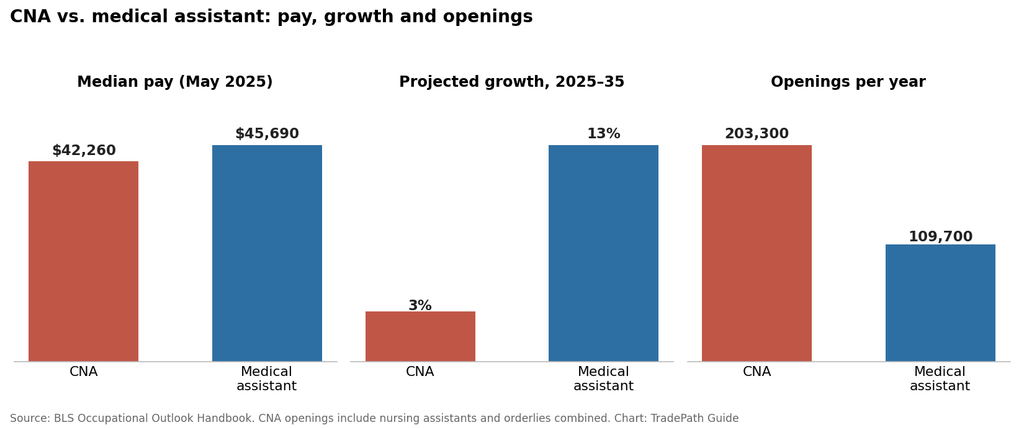
High turnover among CNAs is a double-edged sword. It means jobs are easy to find almost anywhere, but it also reflects how demanding the work is. The BLS lists nursing assistants among the occupations with the highest rates of injuries and illnesses, largely from lifting and moving patients.
Which has the better schedule?
Usually medical assistant. Because most medical assistants work in doctors’ offices, many keep regular daytime hours, although the BLS notes that some work evenings, weekends or holidays in facilities that are open around the clock. For CNAs, nights, weekends and holidays are a normal part of the job, since nursing homes and hospitals never close.
Which is the better path to nursing?
Winner: CNA. Working as a CNA puts you alongside nurses every shift, doing the direct patient care that nursing school builds on. Many nursing programs value or even require that experience. A CNA can also move toward becoming a licensed practical nurse, which the BLS says typically takes about a year of training and pays a median of $64,400.
Medical assisting is the better fit if you’re drawn to outpatient care, like the mix of admin and clinical work, or think you might move into healthcare administration or billing later.
So which should you choose?
- Choose CNA if you need to start working within weeks, want the strongest stepping stone into nursing, and don’t mind physically demanding shifts.
- Choose medical assistant if you can invest one to two years in training, prefer a clinic or office setting with more regular hours, and want somewhat higher pay and faster job growth.
Still deciding? Compare both with other short healthcare and trade programs in our guide to quick certifications that pay well, or see how to become a phlebotomist, another fast route into patient care. If medical assisting is the one for you, here’s how to become a medical assistant step by step.
Data sources: BLS Occupational Outlook Handbook profiles for nursing assistants and medical assistants (May 2025 wages, 2025–2035 projections); federal regulations at 42 CFR 483.152; AAMA and NHA certification pages. Last reviewed October 1, 2026. Requirements vary by state and employer, so confirm details locally.