
Once you’ve finished a phlebotomy program, the next decision is which exam to take. There’s no single national phlebotomy certification: four main organizations offer one, and each has different eligibility rules, fees and renewal requirements. This guide compares the NHA, ASCP, AMT and NCCT credentials side by side, using each organization’s published requirements.
Last reviewed: October 1, 2026. Requirements and fees change, so confirm details with the certifying organization before you apply.
The short version
- NHA CPT: the lowest number of required blood draws (30) and flexible testing options, including live remote proctoring. Common at career schools.
- ASCP PBT: issued by the board that also certifies medical laboratory scientists. A strong choice if you plan to move into lab work later.
- AMT RPT: several routes, including one for people with work experience but no formal program. Requires 50 venipunctures.
- NCCT NCPT: routes tailored to California and Louisiana rules, plus military and work-experience routes.
All four are approved by the California Department of Public Health for its state phlebotomy certificate, which is a good sign of how widely they’re accepted.
Phlebotomy certification comparison table
| NHA | ASCP | AMT | NCCT | |
|---|---|---|---|---|
| Credential | CPT | PBT(ASCP) | RPT | NCPT |
| Main training route | Phlebotomy program in the last 5 years | NAACLS-approved program in the last 5 years | Approved program (at least 120 classroom hours) in the last 4 years | NCCT-authorized program |
| Work-experience route | 1 year in the last 3 years, or 2 years in the last 5 | 1 year full time in the last 5 years | 1,040 hours in the last 3 years | 1 year full time |
| Minimum blood draws | 30 venipunctures + 10 capillary sticks | Varies by route (100 on Route 2) | 50 venipunctures + 10 skin punctures | Varies by state route (50–100) |
| Exam or application fee | See NHA | $155 | $125 (includes first annual fee) | $119 |
| Renewal | Every 2 years, 10 continuing education credits | Credential Maintenance Program | Annual fee + continuing education | Annual renewal + continuing education |
Sources: NHA, ASCP Board of Certification, AMT and NCCT websites (October 2026). All require a high school diploma or equivalent.
How many blood draws you need
The biggest practical difference is the number of successful venipunctures (needle draws from a vein) you must document. If your program’s clinical placement is short, this can decide which exam you’re eligible for.
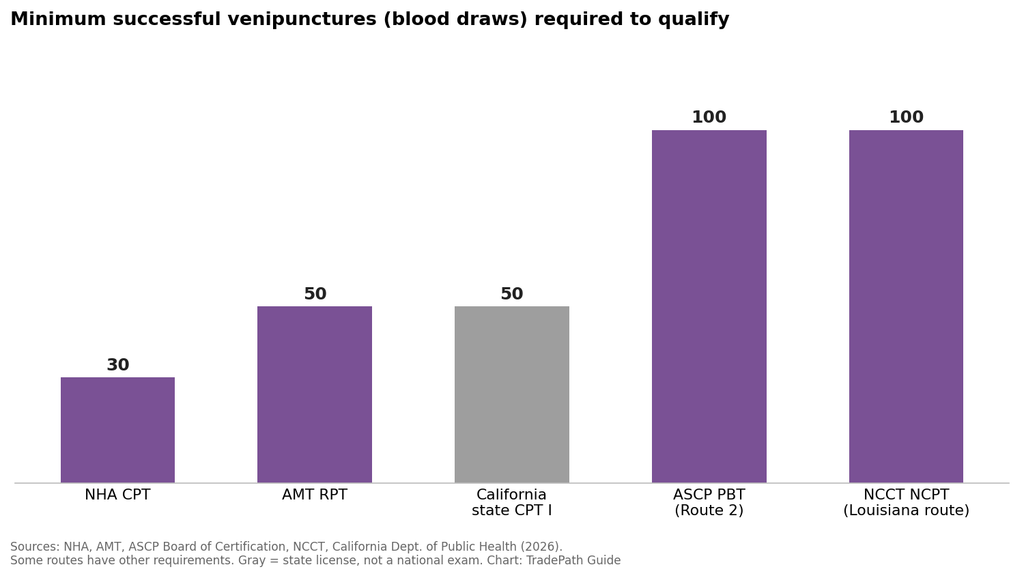
Ask your program early how many supervised draws its clinical rotation guarantees. If it’s around 30, the NHA exam may be your only immediate option; if it’s 100 or more, every credential is open to you.
Each certification in detail
NHA Certified Phlebotomy Technician (CPT)
The National Healthcareer Association requires a high school diploma or equivalent plus either a training program completed in the last five years or supervised work experience (one year in the last three, or two years in the last five). Everyone must document at least 30 venipunctures and 10 capillary sticks on live people.
The exam lasts two hours and can be taken at your school, at a PSI testing center or online with live remote proctoring. NHA says results for online exams are posted within two days of scoring. The credential must be renewed every two years with 10 continuing education credits.
ASCP Phlebotomy Technician, PBT(ASCP)
The ASCP Board of Certification offers seven eligibility routes. The most common are completing a NAACLS-approved phlebotomy program within five years (Route 1), or completing a structured program with 40 classroom hours and 100 clinical hours, including at least 100 successful venipunctures (Route 2). There are also routes for one year of full-time lab experience and for nurses or other allied health professionals. The application fee is $155.
ASCP is best known for certifying medical laboratory scientists and technicians. If you think you might move into laboratory work later, starting with an ASCP credential keeps you within the same certification system.
AMT Registered Phlebotomy Technician (RPT)
American Medical Technologists offers four routes: an approved program with at least 120 classroom hours (within the last four years); 40 classroom hours plus 160 hours of guided work experience; 1,040 hours of phlebotomy work in the last three years; or an instructor route. Every route requires at least 50 venipunctures and 10 skin punctures. The domestic fee is $125, which AMT says covers the application, the exam and the first annual fee.
NCCT National Certified Phlebotomy Technician (NCPT)
The National Center for Competency Testing charges $119 and offers routes for graduates of NCCT-authorized programs, people with at least a year of full-time experience, and current or former military members trained in phlebotomy. It also has routes built around state rules: graduates applying under the California route need 50 venipunctures and 10 capillary punctures, while the Louisiana route requires 100 venipunctures and 25 capillary punctures.
How to choose
Work through these questions in order:
- Does your state regulate phlebotomy? In California, Louisiana, Nevada and Washington, state rules come first. Pick an exam the state accepts and make sure you meet its blood-draw minimums. Our guide on how to become a phlebotomist covers each of those states.
- Which exam does your program prepare you for? Many schools are aligned with one certifying body and may even host the exam on site. Taking that exam is usually the simplest path.
- What do local employers ask for? Search phlebotomy job postings in your area and note which credentials they name. If most say “ASCP preferred,” that’s your answer.
- Where do you want to be in five years? If the answer is a medical lab, ASCP has an edge. If you want to add other credentials such as medical assisting, NHA and AMT certify those roles too.
Whichever you choose, remember that certification is one part of the job search. Phlebotomists earned a median of $45,230 in May 2025, and the BLS notes that employers often prefer certified candidates. For other short credentials you could add later, see our list of quick certifications that pay well.
Sources
- National Healthcareer Association, CPT.
- ASCP Board of Certification, eligibility routes.
- American Medical Technologists, RPT.
- NCCT, Phlebotomy Technician.
- California Department of Public Health, approved certifying organization examinations.
TradePath Guide isn’t affiliated with any certifying organization. This comparison is for general information only.