
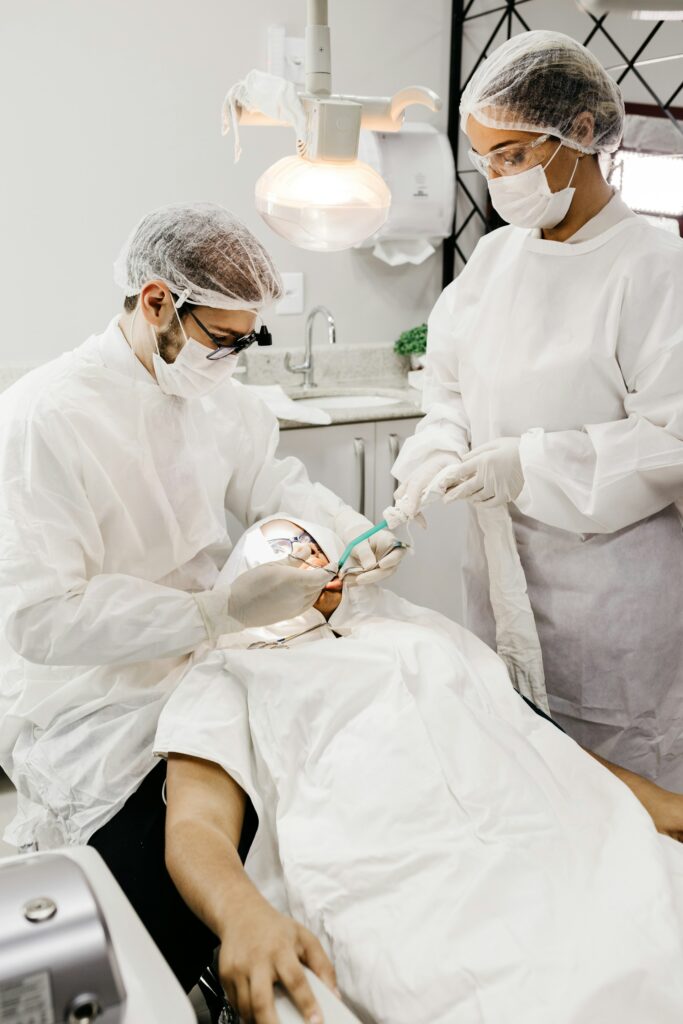
Dental assistants keep a dental office running: they prepare the treatment room, hand instruments to the dentist, take X-rays, sterilize equipment and help patients feel at ease. The job pays a little more than many other entry-level healthcare roles, and programs usually take about a year. But how to become a dental assistant depends heavily on your state, which decides what training you need and which tasks you’re allowed to perform.
Some quick numbers from the U.S. Bureau of Labor Statistics (BLS): dental assistants earned a median of $48,070 in May 2025, there were about 388,600 jobs, and employment is projected to grow 7% through 2035, with roughly 53,000 openings a year. Nearly all of them (91%) work in dentists’ offices.
What dental assistants do
The BLS describes a mix of clinical and office work. On the clinical side, dental assistants prepare patients and treatment areas, sterilize instruments, assist the dentist during procedures and take dental X-rays. On the office side, they keep patient records, schedule appointments and help with billing. They also teach patients about oral hygiene.
Unlike many healthcare jobs, the schedule is usually predictable. Most dental assistants work full time during office hours, though some work evenings or weekends to match the dentist’s schedule.
Why your state matters more than anything else
The BLS notes that requirements vary a lot by state. Some states require graduation from an accredited program and passing an exam; others let you learn on the job with no formal education. Some states also require a separate credential to take X-rays, and states that allow “expanded functions,” such as coronal polishing, usually require a license, registration or certification to perform them.
The terms can be confusing, so here’s what each one means, based on definitions from the Dental Assisting National Board (DANB):
| Term | What it is | Example |
|---|---|---|
| Certificate | Proof you completed a program or course. Doesn’t expire. | A one-year dental assisting program certificate |
| Certification | A national credential earned by exam. Must be renewed. | DANB’s Certified Dental Assistant (CDA) |
| License or registration | State legal permission to perform certain duties. Usually doesn’t transfer between states. | Minnesota’s Licensed Dental Assistant; Michigan’s Registered Dental Assistant |
| Permit | State permission for one specific task. | Sealants, coronal polishing; California’s Orthodontic Assistant permit |
Before you enroll anywhere, look up your state dental board’s rules for dental assistants. DANB also publishes state-by-state requirement summaries on its website.
Two ways to get trained
A dental assisting program. Community colleges, vocational schools and technical schools offer programs that usually take about a year and lead to a certificate or diploma; two-year associate degree programs exist but are less common. Look for programs accredited by the Commission on Dental Accreditation (CODA), because graduating from one is the most direct route to national certification.
On-the-job training. In states that allow it, some people start as untrained assistants and learn in the office. This avoids tuition, but you’ll usually need a lot of experience before you qualify for certification, and you may be limited in the tasks you can perform until you meet state requirements.
The CDA certification
DANB’s Certified Dental Assistant (CDA) credential is the best-known national certification. It’s made up of three component exams:
- GC: General Chairside Assisting
- RHS: Radiation Health and Safety
- ICE: Infection Control
Taken together, that’s 245 questions in 195 minutes. You can qualify in one of three ways:
- Graduate from a CODA-accredited dental assisting or dental hygiene program.
- Have a high school diploma or equivalent and at least 3,500 hours of approved work experience.
- Hold former CDA status, or be a graduate of (or enrolled in) a CODA-accredited dental school program.
Every route also requires current hands-on CPR, BLS or ACLS certification from a DANB-accepted provider. DANB certifications are renewed every year with continuing education.
The Radiation Health and Safety exam is worth knowing about on its own. Because some states require a credential to take X-rays, passing RHS can be useful even before you complete the full CDA.
Just starting out? Look at NELDA
For people who don’t yet qualify for the CDA, DANB offers the National Entry Level Dental Assistant (NELDA) exam: 230 questions in 180 minutes. Eligibility routes include a non-CODA-accredited postsecondary program, a Job Corps dental assisting program, an accredited high school program, or a high school diploma plus 300 to 3,000 hours of verified work experience.
What you can earn
| Measure | Annual pay (May 2025) |
|---|---|
| Lowest-paid 10% | Less than $37,130 |
| Median, all dental assistants | $48,070 |
| Median in dentists’ offices | $48,000 |
| Median in government jobs | $55,270 |
| Highest-paid 10% | More than $62,250 |
That puts dental assistants slightly ahead of medical assistants ($45,690) and well ahead of nursing assistants ($42,260) at the median. Assistants with expanded-function credentials in states that allow them can often take on more responsibility, which may lead to higher pay.
Why demand keeps growing
The BLS points to research linking oral health to overall health, more demand for preventive dental care, and an aging population that keeps more of its natural teeth and needs ongoing care. Since dentists rely on assistants for most chairside and sterilization work, that demand flows directly to this job.
If you’re comparing similar paths, see our guides on how to become a medical assistant and CNA vs. medical assistant. Before paying for any program, our checklist on whether a trade school is legit can help you avoid costly mistakes.
Last reviewed October 2, 2026. Sources: BLS Occupational Outlook Handbook (Dental Assistants); Dental Assisting National Board. Dental assisting rules vary widely by state; confirm with your state dental board.