

Pharmacy technicians count pills, label prescriptions, manage inventory and handle insurance claims so pharmacists can focus on patients. It’s one of the more accessible healthcare jobs: you can start with a high school diploma and learn on the job. But if you’re researching how to become a pharmacy technician, there’s one fact most guides skip: where you work can change your pay more than any certificate does.
Below, you’ll find the two ways into the job, how the PTCB and ExCPT certifications compare, what’s on the national exam and how to aim for the better-paying workplaces.
What pharmacy technicians do
According to the U.S. Bureau of Labor Statistics (BLS), pharmacy technicians help pharmacists dispense prescription medication. Typical tasks include collecting the information needed to fill a prescription, measuring amounts of medication, packaging and labeling prescriptions, organizing inventory, processing insurance claims, entering patient information into computer systems and answering customers’ questions (questions about the medication itself go to the pharmacist).
There were about 471,200 pharmacy technician jobs in 2025. The BLS projects 6% growth through 2035, faster than average, with about 44,700 openings a year, most of them from people leaving the job.
Two ways into the job
On-the-job training. The BLS lists a high school diploma or equivalent as the typical entry-level education, with training on the job that usually takes less than a year. Many retail pharmacies hire trainees and teach them the work.
A formal program. Vocational schools and community colleges offer pharmacy technology programs that lead to a certificate (usually a year or less) or an associate degree. A program costs money, but it can satisfy your state’s education requirement and qualify you to sit for a certification exam right away.
Check your state board of pharmacy first
This step decides which of the two routes makes sense. The BLS notes that most states regulate pharmacy technicians, and requirements may include passing an exam, completing formal education or training, a background check and continuing education. Some states require national certification; others only require registration. Look up your state board of pharmacy’s technician rules before you pay for any program.
PTCB vs. ExCPT: the two national certifications
Two organizations offer the main national credentials, and both use the title Certified Pharmacy Technician (CPhT):
| PTCB (PTCE exam) | NHA (ExCPT exam) | |
|---|---|---|
| Education route | PTCB-recognized education or training program | Pharmacy technician program completed in the last 5 years |
| Work route | At least 500 hours of pharmacy technician work | 1 year with at least 1,200 hours of supervised pharmacy work in the last 3 years |
| Exam | 90 multiple-choice questions (80 scored), 1 hour 50 minutes | 100 questions, at a PSI test center or online with live remote proctoring |
| Fee | $129 | See NHA |
| Renewal | Every 2 years, with continuing education | Every 2 years, with 20 CE hours (including 1 in pharmacy law and 1 in patient safety) |
Which should you pick? First, check which one your state board accepts. If both are accepted, PTCB’s work route is shorter (500 hours versus 1,200), which matters if you’re learning on the job. NHA’s ExCPT can be taken at a test center or from home with live remote proctoring. Ask local employers which one they see more often.
What’s on the PTCE
PTCB publishes a content outline with four knowledge areas. Use the weights to plan your study time:
- Medications (35%): generic and brand names, drug classes, interactions and storage requirements.
- Patient Safety and Quality Assurance (23.75%): high-alert medications, look-alike/sound-alike drugs, and preventing and reporting errors.
- Order Entry and Processing (22.5%): calculations, ratios and conversions, and “sig” codes used on prescriptions.
- Federal Requirements (18.75%): handling, storage and disposal rules, controlled substances and FDA requirements.
Medications alone make up more than a third of the exam, so memorizing the top drugs by brand and generic name is one of the most useful things you can do.
Where you work changes what you earn
The median pharmacy technician earned $45,750 in May 2025, with the lowest 10% under $36,020 and the highest 10% over $61,040. But the averages hide a big split by workplace:
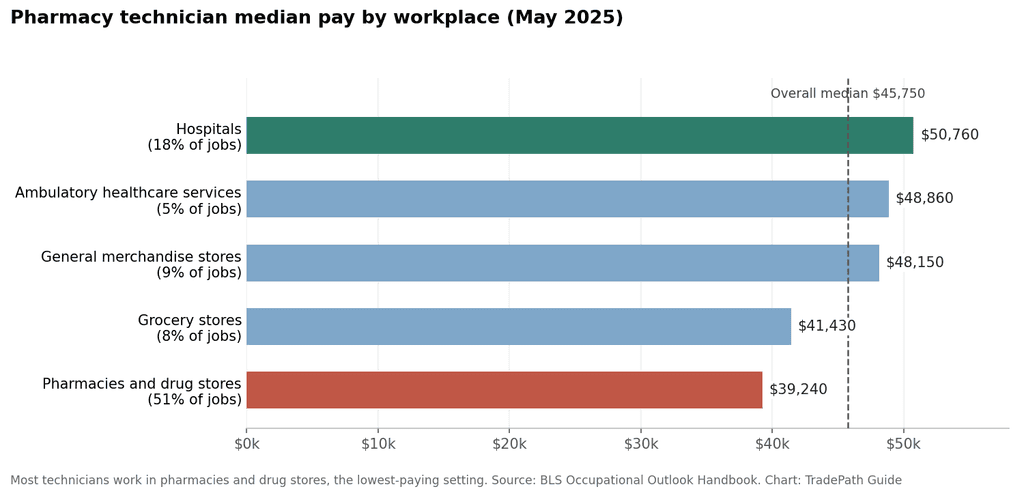
Just over half of pharmacy technicians (51%) work in pharmacies and drug stores, which had the lowest median of the major settings at $39,240. Hospitals, which employ 18%, paid a median of $50,760, about $11,500 more. Hospital roles can involve preparing medications for admitted patients, and some require extra training.
One practical strategy: start in a retail pharmacy, where entry-level jobs are plentiful and on-the-job training is common, earn your certification, then apply to hospital pharmacies once you have experience.
Schedules and the work environment
Most pharmacy technicians work full time, though part-time jobs are common, which makes this a flexible option if you’re studying for something else. Because some pharmacies and hospitals are open 24 hours, nights and weekends may be part of the job. Expect to stand for much of your shift and to deal with busy periods and impatient customers in retail settings.
Going further
Once you’re certified, PTCB offers additional credentials, including an advanced CPhT (CPhT-Adv) and a Certified Compounded Sterile Preparation Technician credential (CSPT), which can help you move into specialized or higher-paying roles. Some technicians use the job as a stepping stone to pharmacy school or other healthcare careers.
If you’re comparing short healthcare paths, see our list of quick certifications that pay well, our guide on how to become a medical assistant, or how phlebotomy compares as another fast entry point.
Last reviewed October 2, 2026. Sources: BLS Occupational Outlook Handbook (Pharmacy Technicians); Pharmacy Technician Certification Board; National Healthcareer Association. State requirements vary; check your state board of pharmacy.