
Last reviewed: October 1, 2026. Pay and job figures come from the U.S. Bureau of Labor Statistics (BLS) Occupational Outlook Handbook, which reports May 2025 wages and 2025–2035 employment projections.
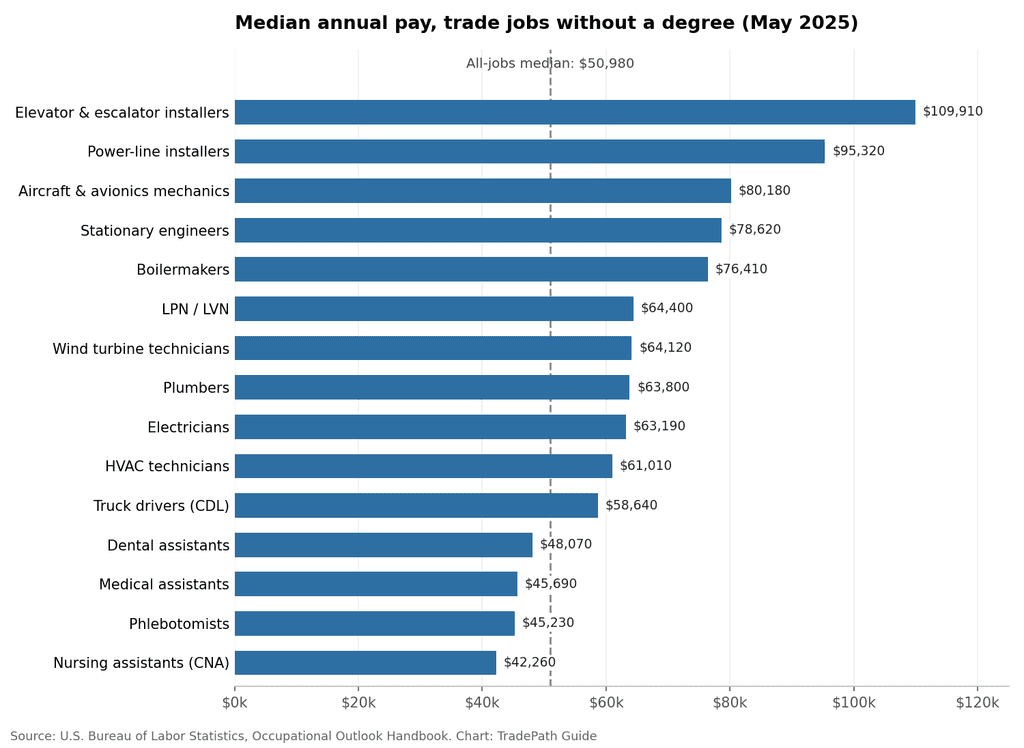
You don’t need a four-year degree to earn a solid living. Many trade jobs without a degree pay more than the national median wage, which the BLS puts at $50,980 per year across all occupations. Most start with an apprenticeship or a training certificate that takes months, not years.
This guide ranks 15 of those jobs by median pay and shows how you get in, how fast each field is growing and how many openings are expected each year.
Key takeaways
- The top-paying trades are learned through paid apprenticeships. Elevator installers, power-line workers and boilermakers all earn more than $75,000 at the median, and apprentices are paid while they train.
- The fastest routes into work are short certificates. Truck driving, phlebotomy and medical assisting programs typically take a few months to a year, but pay less than the apprenticeship trades.
- Growth and openings are not the same thing. Wind turbine technicians have the fastest growth on this list (30%), but truck drivers and nursing assistants have far more openings each year because those fields are much larger.
How we picked these jobs
We included occupations where the BLS lists the typical entry-level education as either a high school diploma (usually followed by an apprenticeship or on-the-job training) or a postsecondary nondegree award, which is a certificate or diploma from a training program that doesn’t lead to an associate or bachelor’s degree. We then ranked them by the 2025 median annual wage.
The highest-paying trade jobs without a degree at a glance
| # | Job | Median pay (2025) | How you typically get in | Growth 2025–35 | Openings per year |
|---|---|---|---|---|---|
| 1 | Elevator and escalator installers | $109,910 ($52.84/hr) | Apprenticeship (4 years); license in most states | +6% | ~1,900 |
| 2 | Electrical power-line installers | $95,320 ($45.83/hr) | Long-term on-the-job training | +10% | ~10,900 |
| 3 | Aircraft and avionics mechanics | $80,180 ($38.55/hr) | Certificate from an FAA-approved program | +6% | ~13,100 |
| 4 | Stationary engineers and boiler operators | $78,620 ($37.80/hr) | Long-term on-the-job training | +3% | ~3,200 |
| 5 | Boilermakers | $76,410 ($36.74/hr) | Apprenticeship (about 4 years) | −2% | ~700 |
| 6 | Licensed practical / vocational nurses (LPN/LVN) | $64,400 ($30.96/hr) | 1-year program + licensing exam | +3% | ~51,800 |
| 7 | Wind turbine technicians | $64,120 ($30.83/hr) | Certificate + on-the-job training | +30% | ~1,500 |
| 8 | Plumbers, pipefitters and steamfitters | $63,800 ($30.67/hr) | Apprenticeship (4–5 years) | +7% | ~42,000 |
| 9 | Electricians | $63,190 ($30.38/hr) | Apprenticeship (4–5 years) | +9% | ~72,700 |
| 10 | HVAC technicians | $61,010 ($29.33/hr) | Certificate (6 months–2 years) + EPA 608 | +11% | ~40,600 |
| 11 | Heavy and tractor-trailer truck drivers | $58,640 ($28.19/hr) | Truck driving school (3–6 months) + CDL | +4% | ~214,500 |
| 12 | Dental assistants | $48,070 ($23.11/hr) | Certificate program | +7% | ~53,000 |
| 13 | Medical assistants | $45,690 ($21.97/hr) | Postsecondary certificate | +13% | ~109,700 |
| 14 | Phlebotomists | $45,230 ($21.75/hr) | Certificate program, usually under 1 year | +7% | ~18,000 |
| 15 | Nursing assistants (CNA) | $42,260 (about $20.32/hr) | State-approved program + exam | +3% | ~203,300* |
Source: U.S. Bureau of Labor Statistics, Occupational Outlook Handbook (2025 median wages, 2025–2035 projections). *Openings figure covers nursing assistants and orderlies combined.
What the numbers tell you
The best-paid trades take the longest to learn, but you’re paid while you learn
The top five jobs on the list are mostly learned through apprenticeships or long periods of on-the-job training. Elevator installers, for example, typically complete a four-year apprenticeship, and the BLS notes that nearly all of them learn the job this way. That sounds like a long commitment, but an apprenticeship is a paid job: you earn a wage from the start, and it usually rises as you progress.
The catch is competition. The highest-paying trades are small. There are only about 24,700 elevator installers and 10,200 boilermakers in the whole country, so apprenticeship spots can be hard to get. Boilermakers are also the only job on this list projected to shrink slightly over the decade.
Electricians, plumbers and HVAC technicians are the “big three”
These three trades combine above-median pay, faster-than-average growth and a large number of openings. Electricians alone are expected to have around 72,700 openings a year. If you want a trade with good pay and plenty of opportunities in most parts of the country, this group is the safest place to start your research. Our guides on how to become an electrician and how to become an HVAC technician cover two of them in detail.
HVAC is the most flexible of the three. You can start through a training program that lasts from six months to two years, or through an apprenticeship. Nearly all HVAC technicians also need the federal EPA Section 608 certification to handle refrigerants.
Healthcare support jobs are the fastest way in, not the best-paid
Phlebotomists, medical assistants, dental assistants and nursing assistants sit at the bottom of this list on pay, below the national median. Their advantage is speed and demand: training usually takes months, and together they account for hundreds of thousands of openings a year. Medical assistants, for instance, are projected to grow 13%, much faster than average.
Many people use these roles as a first step. The LPN/LVN route is the exception within healthcare: it takes about a year and a licensing exam, but the median pay jumps to $64,400.
Fast growth doesn’t always mean lots of jobs
Wind turbine technicians are projected to grow 30%, the fastest on this list. But because the field is small (about 11,800 jobs), that growth translates into roughly 1,500 openings a year. Truck driving grows only 4%, yet it has about 214,500 openings a year, mostly from people retiring or changing jobs. When you compare careers, look at openings as well as growth rates.
Median pay isn’t what you’ll earn on day one
The median is the midpoint: half of workers earn more, half earn less. New workers usually start in the lower half. The BLS also publishes the pay of the lowest-paid and highest-paid 10% of workers, which gives a more realistic picture of the range:
| Job | Lowest 10% earned less than | Median | Highest 10% earned more than |
|---|---|---|---|
| HVAC technicians | $40,050 | $61,010 | $95,210 |
| Truck drivers | $40,140 | $58,640 | $79,380 |
| Phlebotomists | $35,780 | $45,230 | $58,780 |
| Nursing assistants | $33,940 | $42,260 | $51,980 |
Source: BLS Occupational Outlook Handbook, May 2025 wage data.
The spread is widest in the skilled trades. Among HVAC technicians, the top 10% earn more than twice what the bottom 10% earn, while the range in entry-level healthcare roles is much narrower.
Pay depends a lot on where you live
All the figures above are national medians. Wages for the same job can differ widely between states and between cities in the same state, and so do licensing rules. Before you commit to a training program, check local data:
- Wages by state and metro area: the BLS Occupational Employment and Wage Statistics profiles let you pick any occupation and see pay where you live.
- Wages by ZIP code: the U.S. Department of Labor’s CareerOneStop salary finder.
- License requirements by state: the CareerOneStop license finder.
How to choose the right one for you
Pay matters, but it’s only one factor. Before picking a trade, ask yourself:
- How soon do you need an income? If it’s within a few months, look at CDL training or short healthcare certificates. If you can start as a paid apprentice, the long-term pay is higher.
- What kind of work suits you? Several of the best-paid trades involve heights, confined spaces, bad weather or heavy lifting. The BLS lists HVAC technicians, truck drivers and nursing assistants among the occupations with the highest injury rates, and trucking or hospital work often means nights, weekends or time away from home.
- Are there openings near you? A fast-growing field won’t help if there are few jobs in your area. Check local job postings and state data before paying for a program.
- What does the training really cost? Apprenticeships pay you; private certificate programs charge tuition. Compare the total cost, including exams, licenses and equipment, against the pay you can realistically expect in your first years.
Frequently asked questions
What is the highest-paying trade job without a degree?
Among the jobs in this guide, elevator and escalator installers and repairers have the highest median pay, at $109,910 per year in May 2025. They typically need a high school diploma and a four-year apprenticeship, and most states require a license.
Can you make $100,000 in a trade?
Yes, usually with experience. Elevator installers are the only group here with a median above $100,000; in other trades, top earners get close. The highest-paid 10% of HVAC technicians earned more than $95,210.
Which trade can I start the fastest?
Truck driving, phlebotomy and nursing assistant programs are among the quickest. BLS describes truck driving programs as lasting between 3 and 6 months, and phlebotomy programs as usually taking less than a year. Nursing assistant programs must be state-approved, so their length depends on where you live.
Sources
- U.S. Bureau of Labor Statistics, Occupational Outlook Handbook (pay, employment and projections for each job).
- BLS Occupational Employment and Wage Statistics.
- CareerOneStop (U.S. Department of Labor).
This guide is for general information. Training requirements, licensing rules and pay change over time and differ by state, so always confirm details with the official licensing agency and training providers in your area.