
Heating and air conditioning systems break down in every season, which is one reason HVAC work has held up so well. If you’re figuring out how to become an HVAC technician, you have two realistic routes: a training program that takes six months to two years, or a paid apprenticeship that takes several years. Either way, there’s one federal certification you can’t skip.
Some quick context from the U.S. Bureau of Labor Statistics (BLS): HVAC technicians earned a median of $61,010 in May 2025, there were about 440,900 jobs, and employment is projected to grow 11% from 2025 to 2035, much faster than the 3% average. That works out to roughly 40,600 openings a year.
Route 1 or route 2: school or apprenticeship?
| Training program | Apprenticeship | |
|---|---|---|
| Where | Technical and trade schools, community colleges | Employers, unions and contractor associations |
| Length | 6 months to 2 years | Usually several years |
| Credential | Certificate or associate degree | Nationally recognized credential (for registered apprenticeships) |
| Cost | You pay tuition | You’re paid while you train |
| Best for | Getting job-ready fast, with EPA 608 usually included | Learning on the job without student debt |
The BLS describes both paths. School programs cover topics like electrical systems and refrigeration, and graduates usually start alongside experienced technicians, beginning with simple tasks such as insulating refrigerant lines or cleaning furnaces before moving on to soldering pipes and checking circuits. Apprenticeships combine paid on-the-job training with technical instruction each year, including safety, blueprint reading and tool use.
Some employers will also hire people with just a high school diploma. If you’re still in school, the BLS suggests taking vocational courses, math and physics. To find registered apprenticeships near you, search the Department of Labor’s Apprenticeship Finder. For a deeper comparison with real program costs and outcomes, see HVAC apprenticeship vs. trade school.
The certification you can’t skip: EPA Section 608
The U.S. Environmental Protection Agency requires nearly all HVAC technicians who handle refrigerants to be certified. You earn it by passing an EPA-approved exam, which the BLS says is typically included in postsecondary HVAC programs. There are four types:
- Type I: small appliances
- Type II: high- and very high-pressure equipment (most residential and commercial AC systems)
- Type III: low-pressure equipment
- Universal: all of the above
The credential doesn’t expire, which makes Universal certification a smart one-time investment. It’s also one of the fastest credentials you can earn in any trade, which is why it appears on our list of quick certifications that pay well. We explain the exam in detail in our EPA 608 certification guide.
State and local licenses
Licensing is where HVAC gets complicated. The BLS notes that some states and localities require HVAC technicians to be licensed, while others license only the contractors who run HVAC businesses. Requirements can include documented work hours, an exam and continuing education, and they can differ between cities in the same state.
The simplest way to check is the Department of Labor’s CareerOneStop license finder: search “heating, air conditioning and refrigeration” and choose your state. Do this before you pick a program, since your state’s rules may affect whether school or an apprenticeship makes more sense.
Beyond what’s legally required, manufacturers and industry groups offer optional certifications. The BLS notes that some employers prefer or require them, so they can help once you have some experience.
How HVAC pay compares
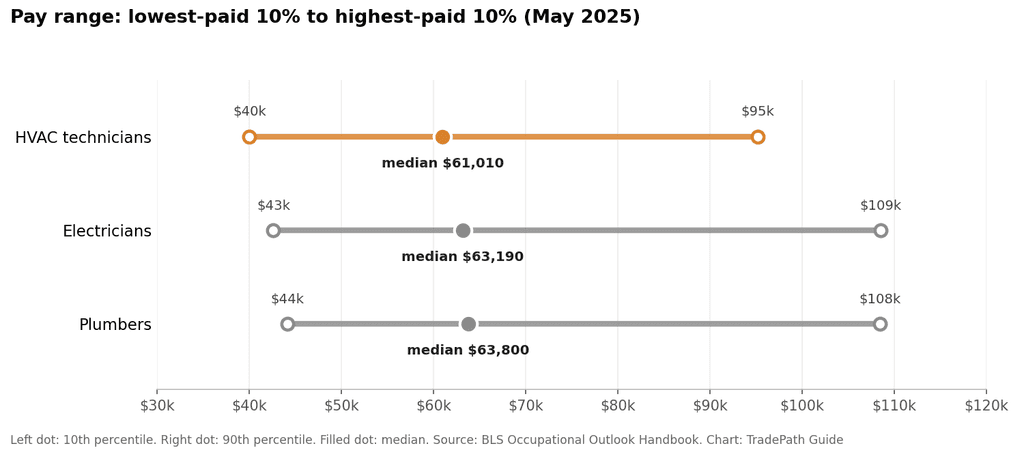
HVAC pays a little less at the median than electrical or plumbing work, and the top end is lower too. But the gap between a beginner and an experienced technician is large in all three trades.
Who you work for matters too. About 68% of HVAC technicians work for plumbing, heating and air-conditioning contractors, where the median was $60,030. The best-paying major employer group was wholesale trade, at a median of $71,190, followed by retail trade ($62,830) and educational services ($62,520). About 6% of technicians are self-employed.
For context on how HVAC stacks up against other well-paid trades, from elevator installers to power-line workers, see our ranking of the highest-paying trade jobs without a degree.
What the job is really like
It’s worth going in with realistic expectations. HVAC technicians often work in attics, crawl spaces, rooftops and buildings where the heat or air conditioning has failed, so you’ll regularly be too hot or too cold. The BLS lists HVAC technicians among the occupations with the highest rates of injury and illness, from burns, electrical hazards and lifting heavy equipment.
Schedules can be uneven. Most technicians work full time, but evenings and weekends are common, many are on call for emergencies, and overtime rises sharply during the peak heating and cooling seasons. On the plus side, the work is varied, you’re rarely at a desk, and modern systems with computerized controls and networking features keep the job technically interesting.
HVAC terms you’ll hear early on
| HVACR | Heating, ventilation, air conditioning and refrigeration. The “R” signals refrigeration work, such as walk-in coolers in grocery stores and restaurants. |
| Refrigerant recovery | Capturing refrigerant from a system instead of releasing it, as federal rules require. This is a core part of the EPA 608 exam. |
| Load calculation | Working out how much heating or cooling a space needs, so the equipment is properly sized. The BLS lists math skills as essential for this. |
| Service agreement | A maintenance contract where a technician regularly inspects a system, cleans ducts, replaces filters and checks refrigerant levels. |
If you’re still weighing a training program against a four-year degree, our breakdown of trade school vs. college compares the cost, time and pay of each path.
Last reviewed October 1, 2026. Sources: BLS Occupational Outlook Handbook (HVAC technicians, electricians, plumbers), U.S. EPA Section 608 rules, U.S. Department of Labor. Licensing rules vary by state and city; confirm locally before you enroll.