
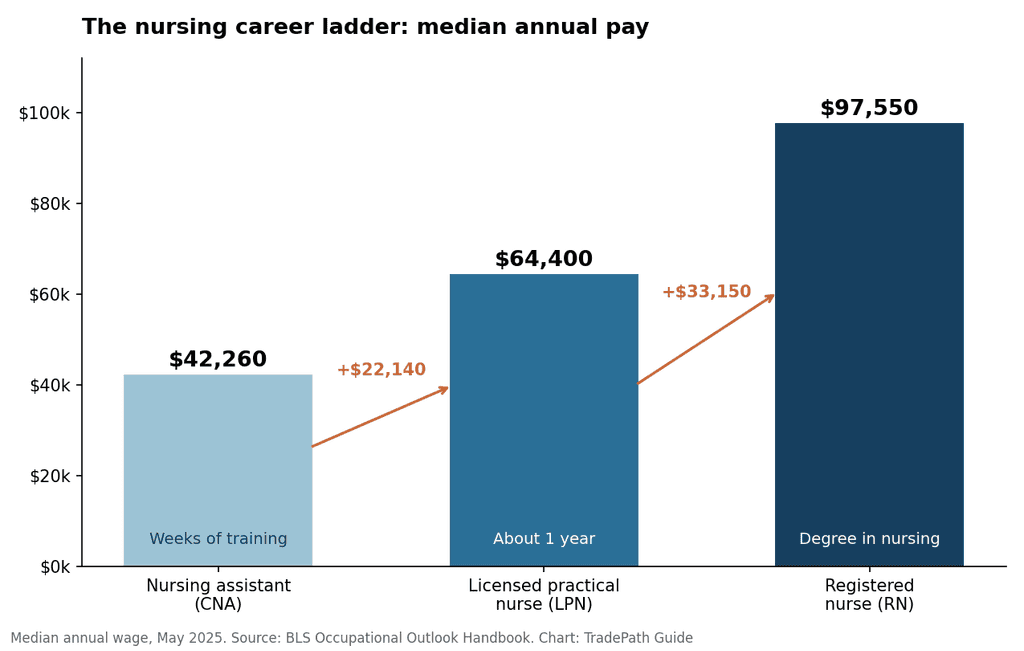
Licensed practical nurses (LPNs) earn a median of $64,400 a year, more than many jobs that take twice as long to train for, and most of them got there through a program that lasts about a year. That combination makes LPN one of the best-value entry points into healthcare. This guide explains how to become an LPN, from choosing a state-approved program to passing the NCLEX-PN, plus what the job pays, where LPNs work and how the role can lead to becoming a registered nurse.
| Training | State-approved certificate or diploma program, typically about 1 year |
| Exam | NCLEX-PN, then a license from your state board of nursing |
| Median pay | $64,400 a year ($30.96 an hour), May 2025 |
| Jobs | About 666,900, with roughly 51,800 openings a year projected through 2035 |
| Also called | Licensed vocational nurse (LVN) in California and Texas |
What an LPN actually does
LPNs provide basic nursing care under the direction of registered nurses (RNs) and doctors. On a typical shift, that means checking vital signs such as blood pressure and temperature, helping patients bathe and dress, changing bandages, keeping health records up to date and reporting changes in a patient’s condition to the RN in charge. According to the BLS, in some states LPNs with the right training may also give medication or start IV drips.
The role sits between two others, and it helps to see where the lines fall:
| Nursing assistant (CNA) | LPN | Registered nurse (RN) | |
|---|---|---|---|
| Main focus | Daily living: bathing, feeding, moving patients | Basic nursing care and monitoring | Assessing patients, planning care, supervising others |
| Training | State-approved program, often a few weeks | About 1 year | Associate or bachelor’s degree in nursing, or a hospital diploma |
| Exam | State competency exam | NCLEX-PN | NCLEX-RN |
| Works under | Nurses | RNs and doctors | Doctors; often supervises LPNs and CNAs |
If you’re still deciding where to start, our guide on how to become a CNA covers the shortest route in, and many LPN students work as CNAs while they train.
How to become an LPN, stage by stage
Stage 1: Meet the entry requirements
Most programs require a high school diploma or GED, and many have an entrance test covering reading, math and science. Expect a criminal background check, a drug screen and proof of immunizations before you start clinical placements, since you’ll be working with patients. Some programs also want you to hold CPR certification or a CNA credential before you begin.
Stage 2: Complete a state-approved program
This is the step that matters most. To take the licensing exam, you must graduate from a program approved by your state’s board of nursing. The BLS says these certificate and diploma programs are commonly offered at community colleges and technical schools, including some high schools, and typically take about a year. Coursework covers nursing fundamentals, anatomy and physiology, and pharmacology, and every program includes supervised clinical experience in real healthcare settings.
Before enrolling, check the program on your state board of nursing’s list of approved schools and ask for its NCLEX-PN pass rate. Many boards publish pass rates by school, and a program whose graduates consistently struggle on the exam is a warning sign. Our checklist on whether a trade school is legit also applies here: because of the clinical hours, a fully online LPN program isn’t possible.
Stage 3: Pass the NCLEX-PN
After graduation, you apply for a license with your state board of nursing and register for the exam with Pearson VUE. Once the board confirms you’re eligible, you receive an Authorization to Test and can schedule your exam.
- Format: the exam is computer-adaptive. According to the 2026 NCLEX-PN test plan, every candidate answers at least 85 items and no more than 150, within a five-hour limit that includes breaks.
- Cost: the registration fee is $200 in the U.S., rising to $350 on February 1, 2027, according to NCSBN. Your state board charges its own license fee on top. If you graduate around the turn of the year, registering before February could save you $150.
- Pass rates: about 87% of first-time U.S.-educated candidates passed in 2025, but only about 42% of those retaking it.
That gap is why preparing properly for the first attempt pays off. Our guide on how to pass your certification exam has a study plan you can adapt.
Stage 4: Get licensed and keep it current
Once you pass and your state issues your license, you can work as an LPN. Licenses must be renewed on a schedule set by your state, and many states require continuing education. The BLS notes that LPNs can also earn optional certifications in areas such as gerontology, wound care and IV therapy, and that many employers prefer CPR or basic life support certification.
Where LPNs work and what they earn
Unlike most healthcare jobs, LPNs earn the most outside hospitals. Nursing homes and similar facilities are both the largest employer and one of the best-paying:
| Workplace | Share of LPN jobs | Median pay (May 2025) |
|---|---|---|
| Nursing and residential care facilities | 37% | $68,020 |
| Hospitals | 16% | $61,160 |
| Home healthcare services | 12% | $63,580 |
| Offices of physicians | 11% | $59,520 |
| Government | 6% | $68,970 |
Pay ranges widely: the lowest-paid 10% earned under $49,740 and the highest-paid 10% over $83,440. Most LPNs work full time, and the BLS notes that many work nights, weekends and holidays, since patients need care around the clock. Those shifts often come with extra pay.
Is there demand for LPNs?
The BLS projects only 3% growth from 2025 to 2035, about average, but that still means roughly 51,800 openings a year as LPNs retire or move into other roles. Longer-term projections are stronger: the Health Resources and Services Administration (HRSA) estimates that the supply of LPNs will meet only 64% of demand by 2037, a much larger gap than it projects for registered nurses. We cover the numbers in more detail in our look at the trades with the biggest worker shortages.
The next step: LPN to RN
For many people, LPN is a stepping stone. Registered nurses earned a median of $97,550 in May 2025, and many nursing schools offer LPN-to-RN bridge programs that give credit for what you’ve already learned, so you don’t start from zero. Working as an LPN while you study also means you’re earning a solid wage during the bridge, and some employers help pay tuition.
Common questions
Is an LPN the same as an LVN?
Yes. The job is the same; only the title differs. California and Texas use “licensed vocational nurse,” and both take the same NCLEX-PN exam.
Can I work as an LPN in another state?
Often, yes. The Nurse Licensure Compact, which covers practical and vocational nurses as well as RNs, lets nurses with a multistate license practice in 43 member jurisdictions. Some large states, including California, aren’t members, so moving there means applying for a separate license.
How can I pay for an LPN program?
Programs at accredited schools are often eligible for federal aid, including Pell Grants, and workforce boards may fund LPN training because it’s in demand. Some nursing homes also sponsor employees. See our guides on how to pay for trade school and how much trade school costs.
Last reviewed October 4, 2026. Sources: BLS Occupational Outlook Handbook (May 2025 wage data, 2025–35 projections); NCSBN (NCLEX-PN test plan, fees and pass-rate data); HRSA National Center for Health Workforce Analysis; Nurse Licensure Compact. Requirements vary by state; check with your state board of nursing.