
You’ve probably heard that the trades are “desperate for workers.” For some jobs, the data backs that up strongly. For others, the shortage is real but narrower than the headlines suggest, and in at least one case economists question whether it exists at all. This guide looks at the trades with the biggest worker shortages using surveys of employers, government projections and labor statistics, and explains what each type of evidence actually tells you.
Three ways to measure a shortage
“Shortage” gets used loosely, so it helps to separate three different signals:
- Employers say they can’t hire. Industry surveys ask companies which positions are hard to fill. This is the most direct sign, but employers sometimes call it a shortage when they simply aren’t offering enough pay.
- Lots of openings. The Bureau of Labor Statistics (BLS) projects how many openings each job will have every year, including those created when workers retire or leave. A large number means plenty of chances to get hired, though not always a shortage.
- Projected supply gaps. Some agencies model how many trained workers there will be compared with how many will be needed. These are forecasts, not facts, but they show where pressure is building.
The strongest cases are the trades where all three point the same way.
What employers are reporting in 2026
The Associated General Contractors of America (AGC) surveyed 1,830 construction firms in July and August 2026. According to its 2026 Workforce Survey, 87% of firms had openings for hourly craft workers, and 88% said those positions were as hard or harder to fill than a year earlier. Among firms trying to hire for each trade, the share reporting difficulty was:
| Craft position | Firms with openings reporting difficulty filling it |
|---|---|
| Electricians | 81% |
| Mechanics | 79% |
| HVAC technicians | 77% |
| Concrete workers | 76% |
| Plumbers, pipelayers and cement masons | Roughly three-quarters |
Half of the respondents said available candidates weren’t qualified because they lacked needed skills, certificates or licenses, and 42% said worker shortages had delayed projects. In other words, firms aren’t short of applicants in general. They’re short of trained applicants, which is exactly the gap a trade program or apprenticeship fills.
Where the most openings will be
BLS projections show how many openings each job is expected to have each year over the next decade. Most of them come from replacing workers who retire or change careers, not from new jobs:
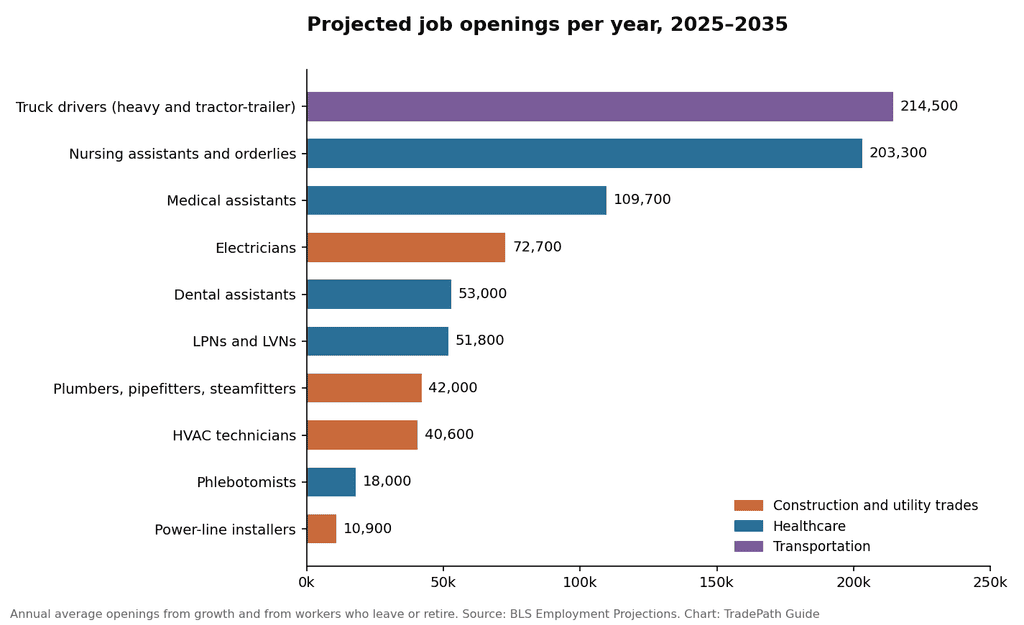
Big numbers here partly reflect how large an occupation is and how often people leave it. Nursing assistants have so many openings largely because turnover is high, not only because demand is growing. A smaller number, like the roughly 10,900 openings a year for power-line installers, can still mean a tight market if few people are trained for the work.
The trades with the strongest evidence
Electricians
Electricians top the AGC’s hard-to-fill list, and the BLS projects about 72,700 openings a year and 9% growth from 2025 to 2035. Retirements add to the pressure: Associated Builders and Contractors (ABC) notes that roughly one-fifth of electricians are over 55. Becoming one takes a four- to five-year apprenticeship, so new workers can’t be produced quickly. Our guide on how to become an electrician explains the path.
HVAC technicians
HVAC technicians combine strong employer demand (77% of hiring firms in the AGC survey reported difficulty) with the fastest projected growth of the three main construction trades, 11% over the decade. The shorter training route, often a certificate of under two years plus EPA 608 certification, makes this one of the quickest ways into a trade in high demand. See how to become an HVAC technician.
Plumbers and pipefitters
About three-quarters of contractors hiring plumbers report trouble finding them, and the BLS projects around 42,000 openings a year. Like electricians, plumbers need a long apprenticeship and a state license, which slows down how fast new workers enter the field.
Licensed practical nurses (LPNs)
In healthcare, the clearest projected gap is for LPNs. The Health Resources and Services Administration (HRSA) projects that the supply of LPNs will meet only 64% of demand by 2037, according to its nursing workforce projections, a larger gap than it projects for registered nurses. LPN programs usually take about a year, and the median pay was $64,400 in May 2025.
The debated case: truck drivers
Trucking is the most famous “shortage” of all. The American Trucking Associations has published shortage estimates in the tens of thousands of drivers for years, and the BLS projects about 214,500 openings a year for heavy and tractor-trailer drivers, more than any other job in this guide.
But a BLS study in the Monthly Labor Review concluded that the market for truck drivers “works about as well as” other blue-collar labor markets. The problem it found was concentrated in long-distance truckload jobs, where annual turnover at large carriers averaged 94%, because many drivers don’t want to stay on the road for weeks at a time. For you, that means getting hired as a new driver is usually easy, but the jobs that are easiest to get are often the ones people leave fastest. Our guides to getting your CDL and company-sponsored CDL training cover what to watch for.
Why these shortages exist
ABC estimates that the construction industry needs to attract about 349,000 new workers in 2026 on top of its normal hiring. Its chief economist said most of that demand comes from retirements rather than more construction. Add long training times and decades of steering students toward four-year degrees, and the pipeline of new tradespeople hasn’t kept up with the number leaving.
What a shortage means for you
- It’s easier to get in. Employers short of workers are more likely to sponsor apprenticeships and pay for training. Our guide on how paid apprenticeships work explains how to find one.
- You have more bargaining power, especially once you’re licensed. Ask about raises, overtime rules and training support before you accept an offer.
- A shortage doesn’t guarantee high pay. Nursing assistants have enormous demand but a median wage of $42,260. Look at pay alongside demand, not instead of it.
- Local conditions matter more than national ones. A national shortage won’t help if your area has few employers in that trade. Check local openings before you commit.
If you’re weighing several of these fields, our guide on how to choose a trade helps you match them to your interests, and our comparison of electrician vs. HVAC vs. plumber puts the three construction trades side by side.
Last reviewed October 4, 2026. Sources: Associated General Contractors of America, 2026 Workforce Survey; BLS Employment Projections and Occupational Outlook Handbook (May 2025 wages, 2025–35 projections); Associated Builders and Contractors (January 2026); HRSA National Center for Health Workforce Analysis; BLS Monthly Labor Review (March 2019).