
Most “best trades” lists rank jobs by pay and stop there. Pay matters, but it’s a poor way to pick the work you’ll do for the next 10 or 20 years. An electrician and a phlebotomist both have good job prospects, yet one spends the day on a ladder in a half-built house and the other spends it talking anxious patients through a needle stick. Knowing how to choose a trade means matching the work to you first and the paycheck second. This guide walks through the questions that actually separate one trade from another, with official data to back up each one.
Start with what a normal day looks like
Before you look at a single salary figure, think about the conditions you’d be happy with on an ordinary Tuesday. Trades that look similar on paper can feel completely different in practice:
| If you prefer… | Trades that tend to fit | Trades that may frustrate you |
|---|---|---|
| Working with people all day | CNA, medical assistant, phlebotomist, dental assistant, EMT | Long-haul truck driving, wind turbine work |
| Working mostly with your hands and tools | Electrician, plumber, welder, HVAC technician | Medical assistant (lots of admin and patient contact) |
| Indoors, in a climate-controlled building | Pharmacy technician, dental assistant, lab-based phlebotomy | Construction trades, power-line work |
| Variety and a different site most days | HVAC service, electrician, plumber, mobile phlebotomy | Pharmacy technician, dental assistant |
| Working alone with little supervision | Truck driving, HVAC service calls | Hospital roles, large construction crews |
| Regular weekday hours | Dental assistant, many medical assistant jobs | Hospital roles, EMT, emergency HVAC and plumbing calls |
If you’re not sure what you like, a structured quiz can help. The Department of Labor’s free O*NET Interest Profiler asks how much you’d enjoy a series of work activities and then suggests careers that match your interests, including many that require only a certificate or an apprenticeship.
Be honest about the physical side
Many trades are physically demanding, and that’s not always obvious from the job title. Electricians, plumbers and HVAC technicians often work in attics, crawl spaces and on roofs, lift heavy equipment, and deal with heat and cold. Truck drivers sit for long hours. CNAs lift and reposition patients, and the BLS notes that nursing assistants have one of the highest rates of injuries and illnesses of all occupations. Even the “easier” healthcare roles involve standing for most of a shift.
Ask yourself three questions: Are you comfortable with heights or tight spaces? Can you handle lifting and working in bad weather? And can you see yourself doing this work at 50? None of these rule a trade out, but if the answer is a firm no, it’s better to know now. A few fields also have specific requirements, such as normal color vision for electrical work (wires are color-coded) and a federal medical exam for commercial drivers.
Decide how long you can train, and whether you need to earn while you do
This is where trades differ the most. Some get you working in weeks; others take four or five years. But the longer routes are usually paid apprenticeships, so “long” doesn’t necessarily mean “expensive.”
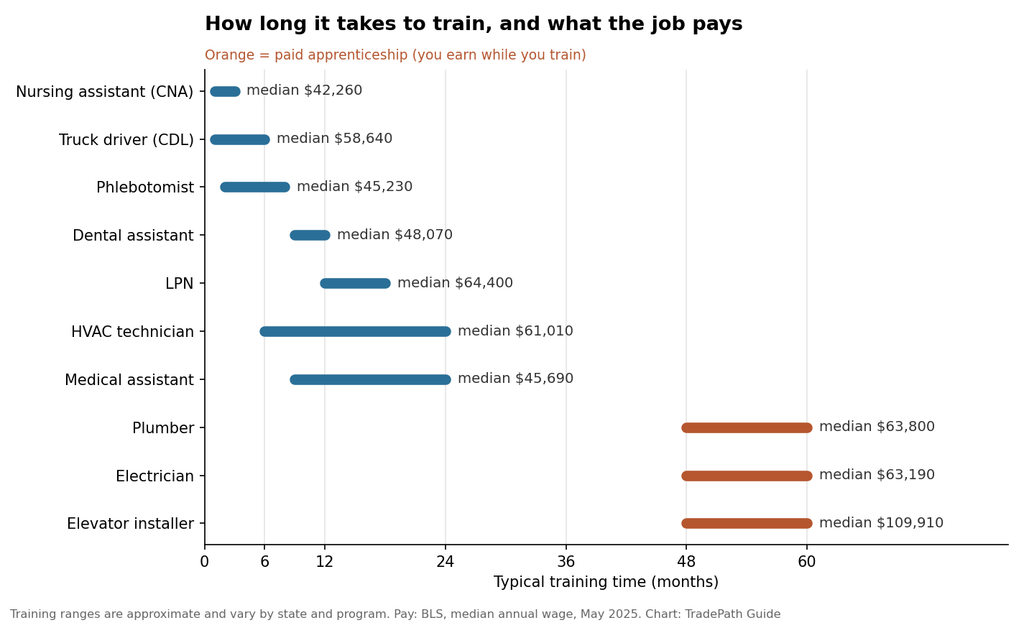
The chart shows three broad groups:
- Fast entry (under about 6 months): CNA, phlebotomy and truck driving. You can start earning quickly, but most of these jobs, apart from trucking, pay below the national median of $50,980.
- Middle route (about 6 months to 2 years): HVAC, LPN, medical and dental assisting. You’ll usually pay tuition, but federal aid often applies, and LPNs and HVAC technicians earn well above the fast-entry jobs.
- Long but paid (4 to 5 years): electricians, plumbers and elevator installers typically train through apprenticeships, where you earn a wage from the start and pay little or no tuition.
If you need income right away, a short program or an apprenticeship works better than a two-year course you’d have to fund yourself. Our guides on how paid apprenticeships work and how much trade school costs can help you compare the real price of each route.
Look at the pay ceiling, not just the median
The median tells you what a typical worker earns. The top of the range tells you how far the trade can take you. Two jobs can start in a similar place and end up far apart:
| Job | Median pay | Top 10% earned more than |
|---|---|---|
| Electrician | $63,190 | $108,510 |
| Plumber | $63,800 | $108,420 |
| HVAC technician | $61,010 | $95,210 |
| Truck driver (heavy and tractor-trailer) | $58,640 | $79,380 |
| Phlebotomist | $45,230 | $58,780 |
| Nursing assistant (CNA) | $42,260 | $51,980 |
Licensed construction trades have the highest ceilings, partly because experienced workers can become master tradespeople, supervisors or business owners. Short healthcare programs have lower ceilings on their own, but they work well as a first step: a CNA can go on to become an LPN or a registered nurse, and a phlebotomist can move into the lab. Our breakdown of what affects a phlebotomist’s salary shows how that progression works, and our list of the highest-paying trade jobs without a degree covers the top of the pay scale.
Check demand where you actually live
National growth rates are a useful starting point. The BLS projects 11% growth for HVAC technicians and 9% for electricians from 2025 to 2035, for example. But you’ll be job hunting in one place, not in the national average. Demand for wind turbine technicians is concentrated where wind farms are; demand for elevator installers is concentrated in big cities with tall buildings.
Two free tools help here. Projections Central shows long-term job projections for each occupation by state, and the Department of Labor’s CareerOneStop salary finder shows local pay. It’s also worth searching job sites for your target trade in your area: dozens of current openings is a much better sign than three.
Consider licensing and how portable the job is
Some credentials travel with you; others don’t. A commercial driver’s license and EPA Section 608 certification are recognized nationwide. Electrician and plumber licenses, on the other hand, are issued by states (and sometimes cities), and moving can mean taking a new exam or meeting new requirements. CNAs are listed on state registries, and transferring to another state usually takes paperwork. If you expect to move, factor that in.
Try it before you commit
Reading about a trade is not the same as doing it. Before you pay for a program or sign an apprenticeship agreement, try at least one of these:
- Talk to two or three people who do the job. Ask what they wish they’d known, what a bad day looks like and whether they’d choose the trade again. Local unions, contractors and hospital HR departments can often put you in touch.
- Shadow someone for a day. Some employers and training programs allow it, and it’s the fastest way to find out if you can handle the conditions.
- Take an entry-level job in the field. Working as a helper for an HVAC or electrical contractor, or as a hospital transporter or unit clerk, shows you the work from the inside while you earn.
- Look for a pre-apprenticeship or short course. A few weeks of hands-on training costs far less than a full program and tells you a lot. An American Job Center can point you to local options, some of them free.
A quick shortcut, depending on your top priority
- “I need a job in a few months.” Look at CNA, phlebotomy or a CDL. Our guide to quick certifications that pay well compares them.
- “I want the highest long-term pay without a degree.” Look at electrician, plumber or elevator installer apprenticeships. See our comparison of electrician vs. HVAC vs. plumber.
- “I want to help people and work in healthcare.” Start with CNA or medical assisting and build from there. Our comparison of CNA vs. medical assistant explains the difference.
- “I can’t afford tuition.” Focus on apprenticeships and employer-paid training, and read our guide on how to pay for trade school for grants you may qualify for.
There’s no single best trade, only the best fit for your interests, your body, your budget and the place you live. Spend a few hours on the questions above before you spend months and thousands of dollars on training, and you’ll be far more likely to choose a trade you stay in.
Last reviewed October 4, 2026. Sources: BLS Occupational Outlook Handbook (May 2025 wage data, 2025–35 projections); U.S. Department of Labor (O*NET, CareerOneStop); Projections Managing Partnership. Training times are typical ranges and vary by state and program.