
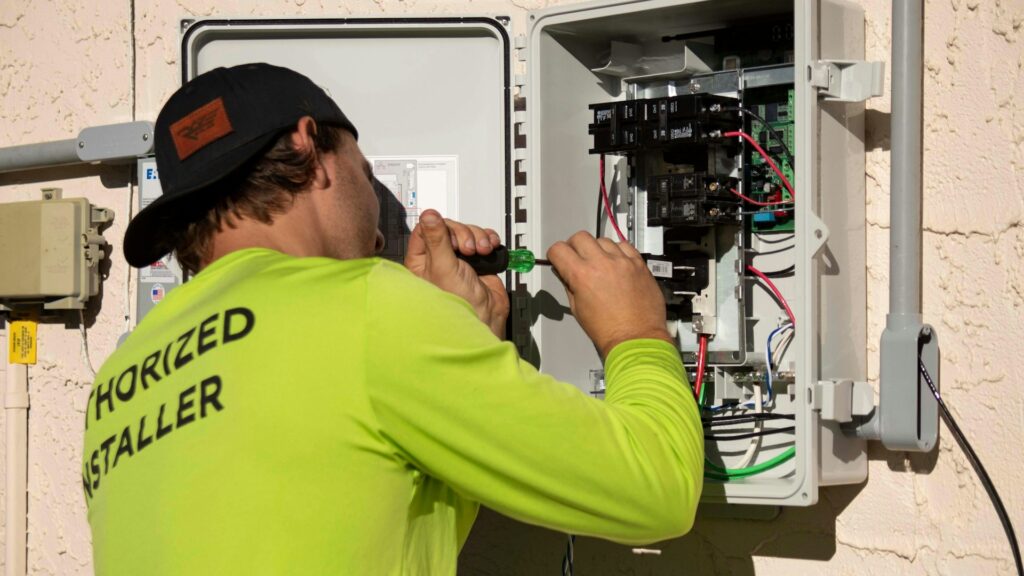
Electricians wire new homes, keep factories running, install solar panels and, increasingly, help build the data centers that power artificial intelligence. It’s one of the largest skilled trades in the country and one of the fastest-growing. If you want to know how to become an electrician, the honest answer is that it takes years rather than months, but you’re usually paid from the first day of training.
This guide walks through the full path, from apprenticeship to journeyman to master electrician, with real licensing requirements from two of the biggest states and official pay and job data.
Electricians at a glance
| Median pay (May 2025) | $63,190 per year ($30.38 per hour) |
| Pay range | Lowest 10% under $42,640; highest 10% over $108,510 |
| Jobs in 2025 | 821,000 |
| Projected growth, 2025–35 | 9%, much faster than the 3% average |
| Openings per year | About 72,700 |
| Typical training | 4–5 year paid apprenticeship |
What electricians actually do
According to the Bureau of Labor Statistics (BLS), electricians install, maintain and repair electrical power, communications, lighting and control systems. On a typical day that can mean reading blueprints, running wire, inspecting transformers and circuit breakers, tracking down faults with testing equipment such as voltmeters and thermal scanners, and making sure everything meets the National Electrical Code and local building rules. Experienced electricians also direct and train apprentices.
The work varies a lot depending on where you end up. Residential electricians work in homes, often dealing directly with customers. Commercial electricians work on offices, stores and larger buildings. Industrial electricians maintain machinery and power systems in factories and plants. Two-thirds of electricians (66%) work for electrical contractors, 7% are self-employed and about 6% work in manufacturing.
Step 1: Get ready in high school (or now)
You’ll need a high school diploma or equivalent to enter most apprenticeships. Math matters more than many people expect: apprentices learn electrical theory and code calculations, and many apprenticeship programs give applicants an aptitude test that includes algebra. Some programs also require a driver’s license, since electricians drive between job sites.
A few personal qualities are close to non-negotiable. The BLS lists color vision (wires are identified by color), troubleshooting and critical-thinking skills, physical stamina and strength (some components weigh up to 50 pounds), and customer-service skills for residential work.
Step 2: Choose how you’ll train
Apprenticeship: the main route
Most electricians learn through an apprenticeship lasting four to five years. For each year of the program, the BLS says apprentices complete about 2,000 hours of paid on-the-job training plus technical instruction in electrical theory, blueprint reading, math, electrical code, safety and first aid. Some programs also cover soldering, communications, fire alarm systems and elevators.
Apprenticeships are sponsored by unions and contractor associations. In practice, that usually means one of two worlds:
- Union programs, run jointly by the International Brotherhood of Electrical Workers (IBEW) and the National Electrical Contractors Association (NECA) through local joint apprenticeship training committees.
- Non-union (“merit shop”) programs, offered through contractor groups such as Independent Electrical Contractors (IEC) and Associated Builders and Contractors (ABC), as well as individual employers.
Both lead to the same licenses. The differences are in how you apply (union programs often have set application windows, an aptitude test and an interview), how wages and benefits are structured, and which contractors you’ll work for. Apply to more than one if you can, since popular programs fill up. The Department of Labor’s Apprenticeship Finder lists registered programs by location.
If you have military or construction experience, the BLS notes that some programs let you complete a shortened apprenticeship.
Technical school: an optional head start
Some people take a technical school program first, covering circuitry, safety practices and basic electrical information. It isn’t required, and you’ll pay tuition instead of earning wages, but it can make you a stronger apprenticeship applicant and, depending on your state, may count toward some of the training you need. If you’re weighing school against other paths, our comparison of trade school vs. college breaks down the costs.
Step 3: Climb the license ladder
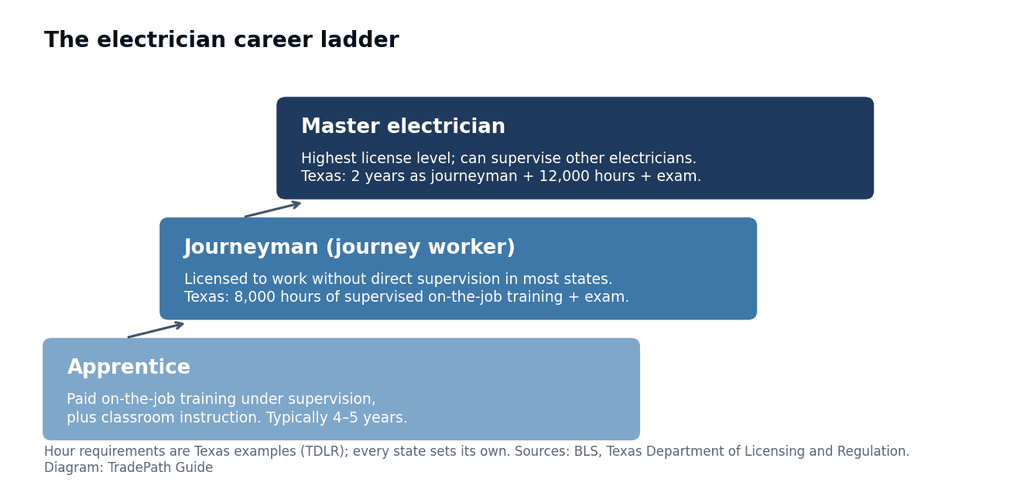
Most states require electricians to be licensed, and the BLS notes that licensing exams typically test your knowledge of the National Electrical Code along with state and local codes. The exact hours and titles differ by state. Here’s how two of the largest states handle it:
| State | Entry license | Experience required | Next level |
|---|---|---|---|
| Texas | Journeyman Electrician | 8,000 hours of on-the-job training under a master electrician, plus an exam | Master Electrician: journeyman license for at least 2 years, 12,000 hours of supervised on-the-job training, plus an exam |
| California | General Electrician certification | 8,000 hours working for an electrical contractor, spread across at least two types of work (such as residential and commercial), plus an exam | Narrower certifications need fewer hours: Residential Electrician (4,800), Fire/Life/Safety Technician and Voice Data Video Technician (4,000 each), Non-Residential Lighting Technician (2,000) |
California’s structure shows a useful option: if you only want to wire homes, the Residential Electrician certification requires 4,800 hours instead of 8,000, so you can qualify sooner. The trade-off is that you’re limited to residential work until you meet the General Electrician requirements. Some other states offer similar residential-only licenses, so it’s worth checking whether yours does.
Texas alone reported more than 227,000 electrician licensees in fiscal year 2025, which gives a sense of how big the trade is in a single state. In both states, and most others, apprentices or trainees must work under the supervision of licensed electricians while they build their hours.
Licenses also have to be maintained. Electricians typically need continuing education to renew, covering safety practices, changes to the electrical code and manufacturer training. Because the National Electrical Code is updated on a regular cycle, keeping up with code changes is part of the job for your whole career.
To look up the requirements in your state, use the Department of Labor’s CareerOneStop license finder and search for “electricians.”
What electricians earn
The median electrician earned $63,190 in May 2025, well above the $50,980 median for all occupations. The range is wide: the top 10% earned more than $108,510, which is one of the highest ceilings among skilled trades. Where you work makes a real difference:
| Employer type | Median annual wage |
|---|---|
| Government | $79,820 |
| Manufacturing | $74,550 |
| Electrical contractors | $61,570 |
| Employment services | $57,760 |
Overtime is common, which can push earnings above these figures. Apprentices earn less than fully qualified electricians, with pay typically rising as they progress through the program. For a comparison with other high-paying trades, see our ranking of the highest-paying trade jobs without a degree.
Why demand is growing
The BLS projects employment of electricians to grow from 821,000 in 2025 to 896,900 in 2035, an increase of about 75,900 jobs. It points to several drivers:
- Ongoing installation and replacement of power systems in homes and businesses.
- Solar and wind systems that need to be connected to buildings and the power grid.
- Artificial intelligence and data centers, which are increasing demand for electricity.
- Upgrades to the national power grid and new infrastructure to expand capacity.
Most of the roughly 72,700 openings each year will also come from electricians retiring or leaving the trade, so opportunities exist even in areas without much new construction.
The realities of the job
Electrical work is physically demanding and carries real risks. The BLS lists electrical shocks, falls and burns among the common injuries, and electricians wear protective clothing and safety glasses. You’ll stand and kneel for long periods, work in cramped spaces and, on construction sites or renewable energy projects, sometimes work at heights or outdoors in extreme temperatures.
Almost all electricians work full time, and evenings, weekends and overtime are common. On the other hand, self-employed electricians, particularly in residential work, often set their own schedules, and the license gives you a portable skill you can use almost anywhere in the country.
Where you can go from here
Once licensed, electricians can move in several directions. Journey workers can become master electricians, supervisors or project managers. Others specialize: the BLS notes optional certifications in areas such as solar photovoltaic systems, electrical generating systems and lighting systems. And some go on to start their own electrical contracting business.
Electrical skills also overlap with other trades. If you’re still deciding, our guide on how to become an HVAC technician covers a related trade with a shorter training path, and our comparison of electrician vs. HVAC vs. plumber puts all three side by side.
Common questions
How long does it take to become an electrician?
Usually four to five years to complete an apprenticeship and qualify as a journeyman. Reaching master electrician takes longer. In Texas, for example, you need at least two years as a journeyman and 12,000 hours of supervised experience.
Do you get paid during an electrician apprenticeship?
Yes. Apprentices are employees and earn wages for their on-the-job training, about 2,000 hours a year according to the BLS. Pay usually increases as you advance through the program.
Is a union apprenticeship better than a non-union one?
Neither is automatically better. Both can lead to a state license. Compare the specific programs near you on application requirements, starting wage, benefits, and the type of work their contractors do.
Last reviewed October 2, 2026. Sources: BLS Occupational Outlook Handbook (Electricians); Texas Department of Licensing and Regulation; California Department of Industrial Relations, Electrician Certification Unit; U.S. Department of Labor. Licensing rules vary by state and change over time.