
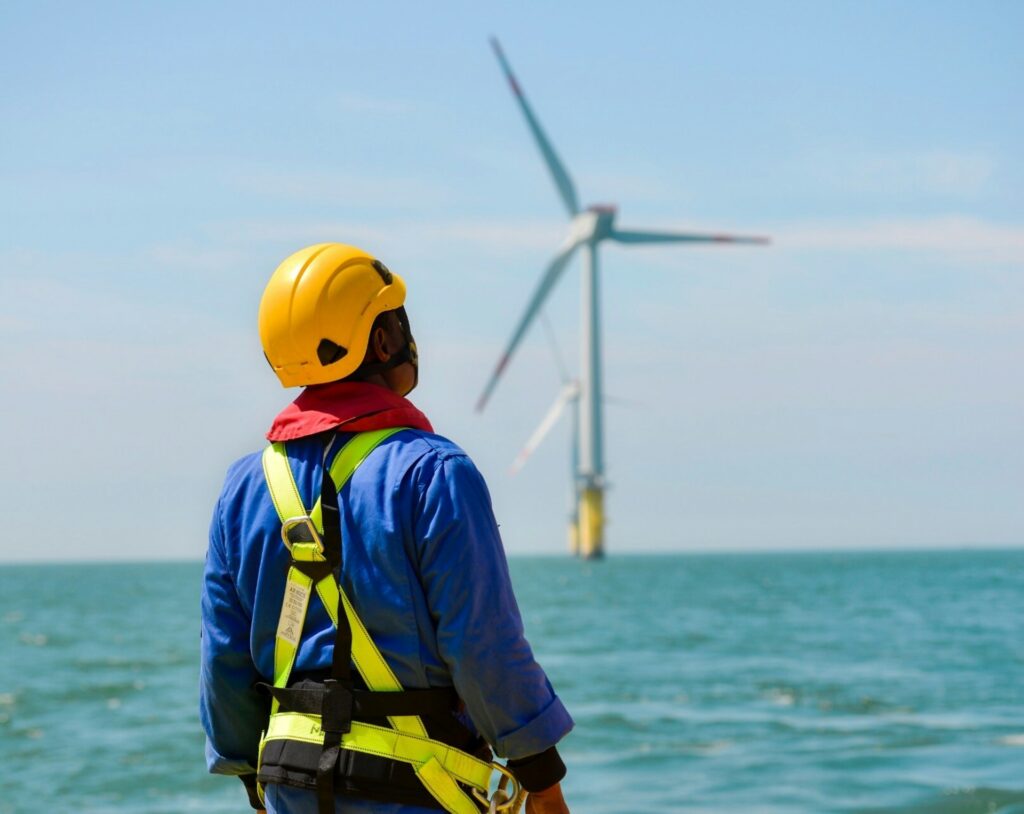
Wind turbine technicians have one of the fastest projected growth rates of any U.S. occupation: the Bureau of Labor Statistics (BLS) expects employment to rise 30% from 2025 to 2035. The work also pays well for a job you can enter with a certificate, at a median of $64,120 a year. But it’s a small occupation with a very specific set of demands, starting with climbing towers that can be taller than a 20-story building. Here’s how to become a wind turbine technician and what to know before you commit.
What the job involves
Wind turbine technicians, often called windtechs, inspect, maintain and repair turbines. According to the BLS, that includes routine maintenance as well as testing and troubleshooting electrical, mechanical and hydraulic components. Much of the work happens inside the nacelle, the housing at the top of the tower, which means climbing towers that can exceed 200 feet, often using ladders inside the tower, though many newer turbines have lifts. Technicians also collect data and monitor turbines from the ground.
It’s a job that combines several trades. A single day might involve electrical diagnostics, replacing a hydraulic part and tightening bolts on a gearbox, so mechanical and electrical aptitude both matter.
How to become a wind turbine technician
1. Earn a certificate in wind energy technology
The BLS says most technicians complete a postsecondary certificate in wind energy technology at a technical school or community college. Some earn an associate degree, which can help with later promotions. Courses cover electrical and hydraulic systems, safety, rigging and turbine mechanics. Look for programs with a climbing tower or a working turbine on site, and ask about relationships with local wind farm operators.
Experience in a related trade can also get you in. People with backgrounds as electricians, industrial mechanics or military technicians sometimes move into wind work with less additional training.
2. Get safety certified
Most wind employers expect safety training based on standards from the Global Wind Organisation (GWO), a non-profit founded by wind turbine owners and manufacturers. Its Basic Safety Training has several modules:
| Module | Who needs it |
|---|---|
| First Aid | Onshore and offshore |
| Manual Handling | Onshore and offshore |
| Fire Awareness | Onshore and offshore |
| Working at Heights | Onshore and offshore |
| Sea Survival | Offshore only |
Some school programs include GWO training; otherwise, private training centers offer it, and the full onshore package can usually be completed in a few days. Many employers also want CPR certification and a valid driver’s license, since wind farms are often far from towns.
3. Complete on-the-job training
Once hired, you’ll get employer- or manufacturer-provided training, which the BLS says typically lasts about 12 months. You’ll learn the specific turbine models your employer services, often working alongside experienced technicians before you’re trusted on your own.
Pay and where the jobs are
Wind turbine technicians earned a median of $64,120 ($30.83 an hour) in May 2025. The lowest-paid 10% earned under $49,230 and the highest-paid 10% over $92,460. Pay varies by type of employer:
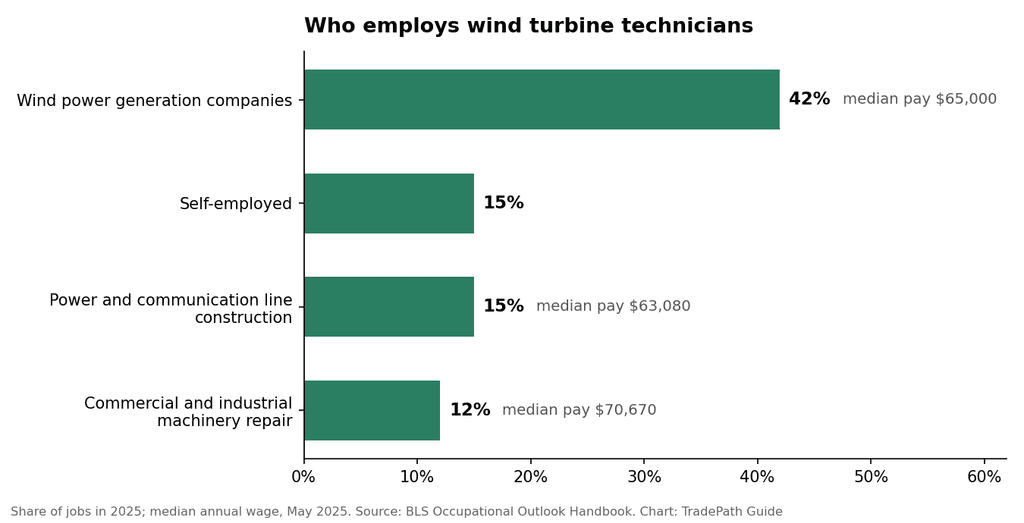
Location matters even more than employer. Wind farms are concentrated in windy, mostly rural parts of the country. According to the U.S. Energy Information Administration, Texas, Iowa, Oklahoma, Kansas and Illinois produced about 52% of all U.S. wind electricity in 2025. If you live far from wind country, expect to relocate or travel. Some technicians work for service companies that send them to different sites for weeks at a time.
The growth figure, in context
A 30% growth rate sounds enormous, and it is in percentage terms. But wind turbine technician is a small occupation, with only about 11,800 jobs in 2025 and roughly 1,500 openings a year projected. Compare that with about 40,600 openings a year for HVAC technicians or 72,700 for electricians. Demand also depends on how many new wind projects are built, which can change with energy policy and the economy. Fast growth is a good sign, but it doesn’t mean jobs are easy to find everywhere.
Is it the right job for you?
Be honest with yourself about heights first. The BLS lists the ability to work at heights and physical strength, including lifting more than 50 pounds, among the key qualities for the job. Technicians work outdoors in all weather, in cramped spaces inside the nacelle, and some are on call for evening and weekend repairs.
If that sounds exciting rather than terrifying, wind can be a rewarding trade with strong pay for a short training period. If you like the electrical side but would rather stay closer to the ground, look at becoming an electrician, or compare options in our guide on how to choose a trade. You can also see how wind compares with other well-paid jobs in our list of the highest-paying trade jobs without a degree.
Last reviewed October 4, 2026. Sources: BLS Occupational Outlook Handbook (May 2025 wage data, 2025–35 projections); U.S. Energy Information Administration; Global Wind Organisation via MITAGS. Training requirements vary by employer.